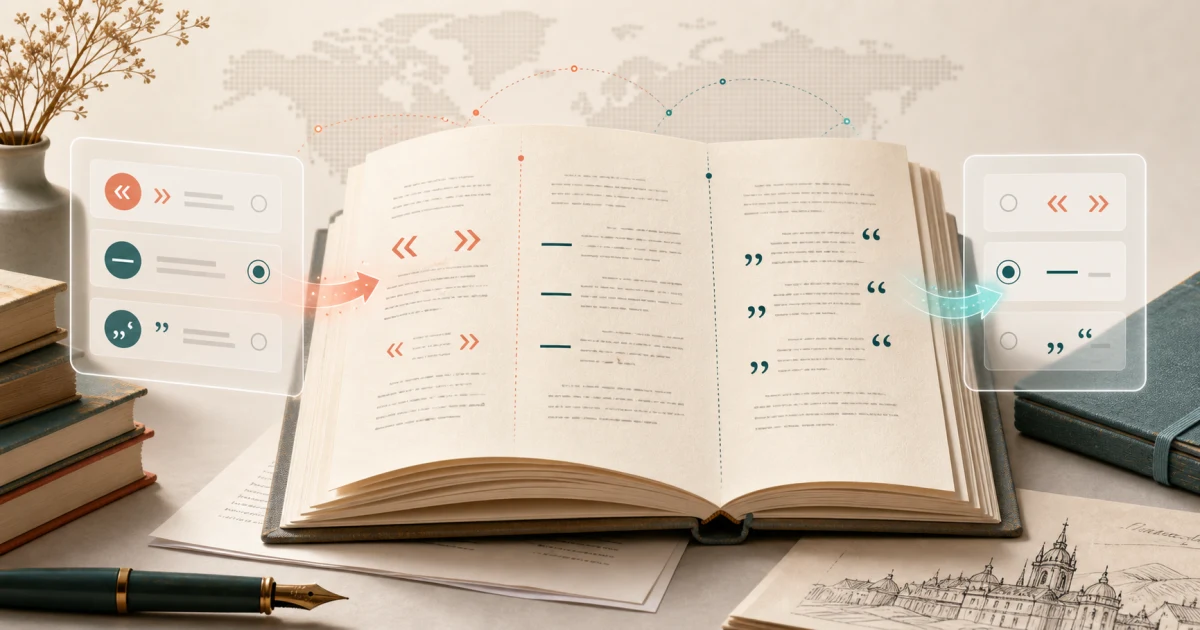
How to convert French guillemets into dialogue dashes
If you need to convert a French manuscript from guillemets (« Bonjour », dit-elle.) into dash-style dialogue (— Bonjour, dit-elle.), do not treat it as a simple search-and-replace job. A novel contains dialogue tags, quoted phrases in narration, letters, remembered speech, and nested quotations. Those cases need different handling.
Bookshift's Dialogue Format Converter is built for this exact problem. It keeps the manuscript in French and changes only the dialogue punctuation convention.
Quick answer
- The useful French terms are guillemets français, tirets de dialogue, tiret cadratin, and mise en forme des dialogues.
- A global replacement can damage citations and non-dialogue quoted text.
- Decide whether your target style is French guillemets or French em-dash dialogue before conversion.
- Use Bookshift when you need to convert a whole DOCX or EPUB and keep the book structure intact.
Guillemets vs. French dialogue dashes
French fiction commonly uses two dialogue presentations:
| Style | Example | Search terms |
|---|---|---|
| French guillemets | « Bonjour », dit-elle. |
guillemets français, guillemets typographiques |
| Dialogue dash | — Bonjour, dit-elle. |
tiret de dialogue, tiret cadratin, dialogue au tiret |
The — mark is an em dash. French writers and editors often call it a tiret cadratin or tiret de dialogue when it opens speech.
Why search-and-replace fails
In a real manuscript, not every quoted passage is speech. You may have:
- dialogue tags such as
dit-elle,répondit Paul, ormurmura-t-il; - quoted phrases inside narration;
- letters, signs, messages, and remembered speech;
- nested quotations;
- paragraphs where a character speaks and then acts.
Replacing every « with — can turn a normal quotation into a dialogue line. Removing every » can break a sentence that should still be quoted.
A safer conversion workflow
- Identify the current convention. Does the manuscript mostly use
« ... », or does it already open dialogue with—? - Choose the target convention. Follow your publisher's style sheet, your editor's instruction, or your own edition standard.
- Work from a copy. Keep the original DOCX or EPUB unchanged.
- Convert dialogue by context. A speech paragraph needs different treatment from a quotation inside narration.
- Review ambiguous sections. Letters, long quotations, and nested dialogue deserve a human check.
How Bookshift helps
The Bookshift Dialogue Format Converter accepts DOCX, EPUB, Markdown, TXT, HTML, and HTM manuscripts. After upload, it attempts to detect the manuscript language and dominant dialogue convention, then proposes the opposite conversion direction.

This is not translation. It does not rewrite the prose or change the meaning. It converts the selected dialogue punctuation convention and returns usable manuscript outputs such as editable DOCX and EPUB files.
Common mistakes
Using a hyphen instead of an em dash
French dash dialogue uses —, not -. A short hyphen is not a professional substitute for an opening dialogue dash.
Converting non-dialogue quotations
Elle se souvenait de « la maison bleue ». is not automatically a dialogue line. A converter has to distinguish quoted text from spoken dialogue.
Mixing conventions without a rule
There can be legitimate reasons to use guillemets inside dash dialogue, especially for quotations within speech. But a manuscript that switches between systems without a clear rule looks unfinished.
Pre-publication checklist
- The manuscript uses one main dialogue convention consistently.
- Dialogue tags still read naturally after conversion.
- Letters, signs, messages, and quotations have not been converted by mistake.
- Nested dialogue remains understandable.
- The DOCX keeps chapter headings and scene breaks.
- The EPUB has been opened in an ereader before publication.
FAQ
How do I convert French guillemets to dialogue dashes?
For a whole manuscript, convert by dialogue context rather than replacing individual punctuation marks. Bookshift automates that conversion for French manuscripts.
Is "tiret cadratin" the same as a dialogue dash?
In this context, yes. "Tiret cadratin" names the em dash character —; "tiret de dialogue" describes its use in dialogue.
Does Bookshift translate the manuscript during conversion?
No. The Dialogue Format Converter keeps the manuscript in the same language and changes only the dialogue punctuation style.
Can I upload an EPUB?
Yes. The converter accepts EPUB as well as DOCX, Markdown, TXT, HTML, and HTM.
Should I proofread after conversion?
Yes. A final review is still wise, especially in chapters with letters, nested quotations, or unusual dialogue formatting.
Bottom line
The real task is not "replace guillemets with dashes." It is convert French dialogue formatting without damaging the manuscript. That is what the Bookshift Dialogue Format Converter is designed to do.