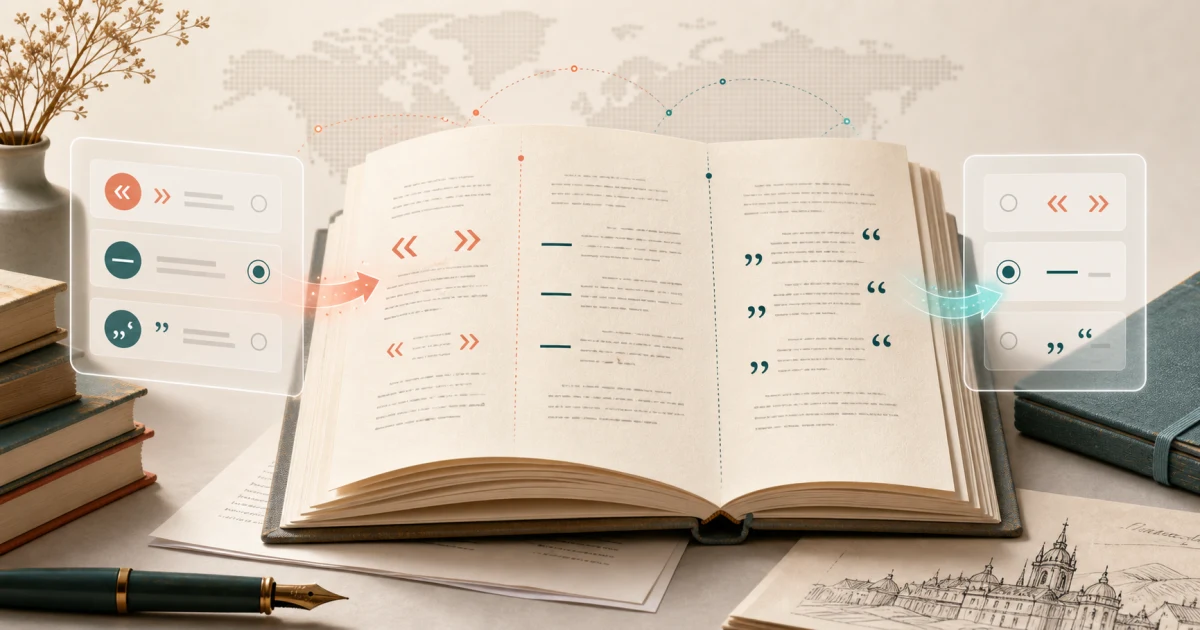
How to convert Guillemets to German quotation marks
If a German manuscript uses Guillemets or Chevrons (»Guten Morgen«, sagte sie.) but your publisher, editor, or house style wants German low-high quotation marks („Guten Morgen“, sagte sie.), the change looks deceptively simple. In a novel, it is not.
A good conversion has to recognize wörtliche Rede (direct speech), quoted phrases in narration, nested quotations, and text that should not be treated as dialogue. Bookshift's Dialogue Format Converter handles this as a manuscript-formatting problem, not as a crude character replacement.
Quick answer
- Useful German search terms include Guillemets, Chevrons, deutsche Anführungszeichen, Anführungszeichen unten und oben, Gänsefüßchen, and wörtliche Rede.
- Bookshift supports German conversion in both directions:
»...«to„...“, and„...“to»...«. - Search-and-replace is risky because direct speech, quotations, titles, thoughts, and nested speech are not the same thing.
- Decide which style your German edition requires before converting.
The two common German dialogue styles
German books commonly use either:
| Style | Example | Common terms |
|---|---|---|
| German quotation marks | „Guten Morgen“, sagte sie. |
deutsche Anführungszeichen, unten und oben, Gänsefüßchen |
| Guillemets / Chevrons | »Guten Morgen«, sagte sie. |
Guillemets, Chevrons, französische Anführungszeichen |
Both appear in published books. The goal is consistency with the edition's style, not proving one system is universally correct.
Why this is difficult in a book manuscript
Dialogue punctuation interacts with:
- speech tags such as
sagte sie,fragte er, orflüsterte Anna; - quotations inside direct speech;
- letters, signs, messages, and cited text;
- thoughts or remembered phrases;
- paragraphs mixing narration and speech.
Replacing every » with „ and every « with “ might appear to work on page one. It can fail badly once the manuscript contains nested speech or non-dialogue quotations.
Recommended workflow
- Identify the source style. Does the manuscript mainly use
»...«or„...“? - Confirm the target style. Follow the publisher's style sheet, editor notes, or your own German edition standard.
- Preserve the original. Never work on the only copy of the manuscript.
- Convert by context. Dialogue paragraphs and ordinary quotations need different handling.
- Review edge cases. Pay special attention to letters, chat messages, epigraphs, indented quotations, and nested speech.
How Bookshift helps
The Bookshift Dialogue Format Converter keeps the German text, structure, and meaning intact while changing the selected dialogue convention.
For German manuscripts, it supports:
- Guillemets to German quotation marks:
»Guten Morgen«, sagte sie.→„Guten Morgen“, sagte sie. - German quotation marks to Guillemets:
„Guten Morgen“, sagte sie.→»Guten Morgen«, sagte sie.
The converter accepts DOCX, EPUB, Markdown, TXT, HTML, and HTM. It attempts to detect the language and source style after upload. If detection is uncertain, the selections remain editable instead of forcing a conversion direction.
Common mistakes
Confusing straight quotes with German typography
"Guten Morgen" is not the same as „Guten Morgen“. Straight quotes often come from drafts or plain-text exports; a publication manuscript usually needs typographic marks.
Using Guillemets in the wrong direction
German Guillemets are commonly written as »...«. Other languages may use the opposite direction. A conversion tool should know the language convention, not just the character shape.
Treating every quote as dialogue
Sie nannte es „den alten Fehler“. is quoted text, but it is not necessarily a dialogue line. That distinction matters during conversion.
Checklist before publication
- The manuscript has one main dialogue convention.
- Direct speech remains grammatically correct after conversion.
- Quotations in narration were not turned into dialogue.
- Nested speech is still readable.
- The DOCX remains editable for final proofing.
- The EPUB has been opened and checked visually.
FAQ
How do I convert Guillemets to German quotation marks?
For individual sentences, you can edit manually. For a whole novel, a context-aware converter is safer because it distinguishes direct speech from other quoted text.
What are Chevrons in German typography?
Chevrons are another name for Guillemets such as »...«. Many German writers also call them französische Anführungszeichen.
What does "Anführungszeichen unten und oben" mean?
It usually refers to German low-high quotation marks: opening below, closing above, as in „...“.
Can Bookshift convert German quotation marks back to Guillemets?
Yes. German conversion works in both directions.
Does this edit or translate the text?
No. It changes the dialogue punctuation convention only.
Bottom line
When someone searches for Guillemets in deutsche Anführungszeichen umwandeln, they usually have a manuscript problem, not a punctuation trivia problem. The Bookshift Dialogue Format Converter is designed to make that conversion while preserving the book.