
What's new in Bookshift: cleaner files and clearer publishing steps
It has been a while since the last published Bookshift update, so this is a catch-up post covering several weeks of changes.
The short version: the last few weeks have been less about one giant new button and more about making the whole publishing path steadier. Cleaner translated EPUBs. Better DOCX output. Clearer cover actions. More accurate print wraps. Safer follow-up when authors add another language later. A bit of audiobook progress too, though I am keeping that part measured until it is ready for more beta testing.
That is the theme: fewer confusing handoff moments between "my book is translated" and "I can review, upload, and publish this edition."
Cleaner translated EPUBs, especially for Japanese, Korean, and Chinese
One of the bigger improvements has been translated ebook output.
Japanese, Korean, and Chinese editions need more care than a simple left-to-right EPUB conversion. Line breaks, punctuation, reading conventions, and retailer expectations can all behave differently. A file can open in a reader and still not feel like a file I would want an author to upload.
Bookshift now does more cleanup before those final EPUB files are ready, with better page layout, punctuation, line breaks, and final file checks. There has also been work to make these files behave better in stores and readers where East Asian translated editions often end up, including Taiwan retailers such as Kobo and Readmoo.
Most authors should not have to think about the machinery here. The point is simple: if you translate into Japanese, Korean, or Chinese, the final ebook should feel less like a converted file and more like a real edition.
Finished manuscript files got sturdier
There was also a lot of work on the finished files authors actually download and inspect.
Scene breaks are a good example. Bookshift now does a better job recognizing scene divider lines and carrying them through the finished files. That includes obvious dividers like three asterisks, but also common manuscript variants: spaced asterisks, repeated dots or bullets, em-dash dividers, and a few ornamental divider characters.
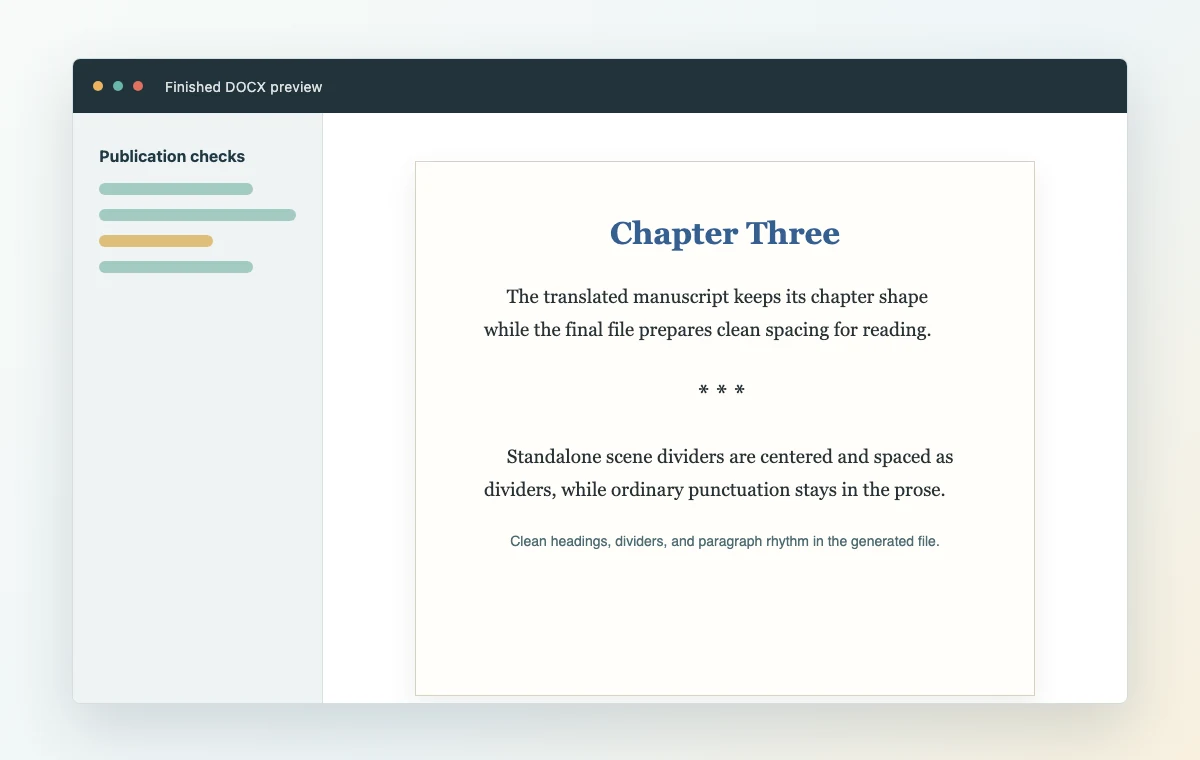
The useful part is not just that real scene breaks are centered and spaced more consistently in DOCX, EPUB, HTML, and text outputs. It is also that normal punctuation inside a paragraph is less likely to be mistaken for structure.
Generated DOCX files also got a small readability pass. Chapter and section headings now use a darker blue, so they should be easier to read when you open the file in Word, Pages, print preview, or a PDF export. This also helps with Tolino, which has stricter file requirements than many other retailers.
These are small details until they are not. A translated novel can be strong on the sentence level and still feel unfinished if scene dividers disappear, headings look washed out, or the file needs manual cleanup before review.
EPUB intake and EPUB links are less fragile
Two less visible EPUB fixes are worth calling out because they help with messy real-world files.
First, Bookshift is more tolerant of EPUBs that include protected-font information. Some EPUBs include an encryption.xml file because the fonts are protected, not because the book itself is locked. Bookshift now tells those cases apart more carefully, so valid uploads are less likely to be rejected for the wrong reason.
Second, Bookshift can fix more small mismatches inside EPUB files, including cases where punctuation or underscores do not exactly match the packaged file names. That helps reduce reader and retailer issues caused by EPUBs that are close to correct but still not clean enough for reliable distribution.
EPUB links also got a readability pass. If a translated EPUB includes links inside the book, table-of-contents links, author-note links, or other linked resources, those links should not depend on color alone. Bookshift now makes links blue and underlined in the finished EPUB file.
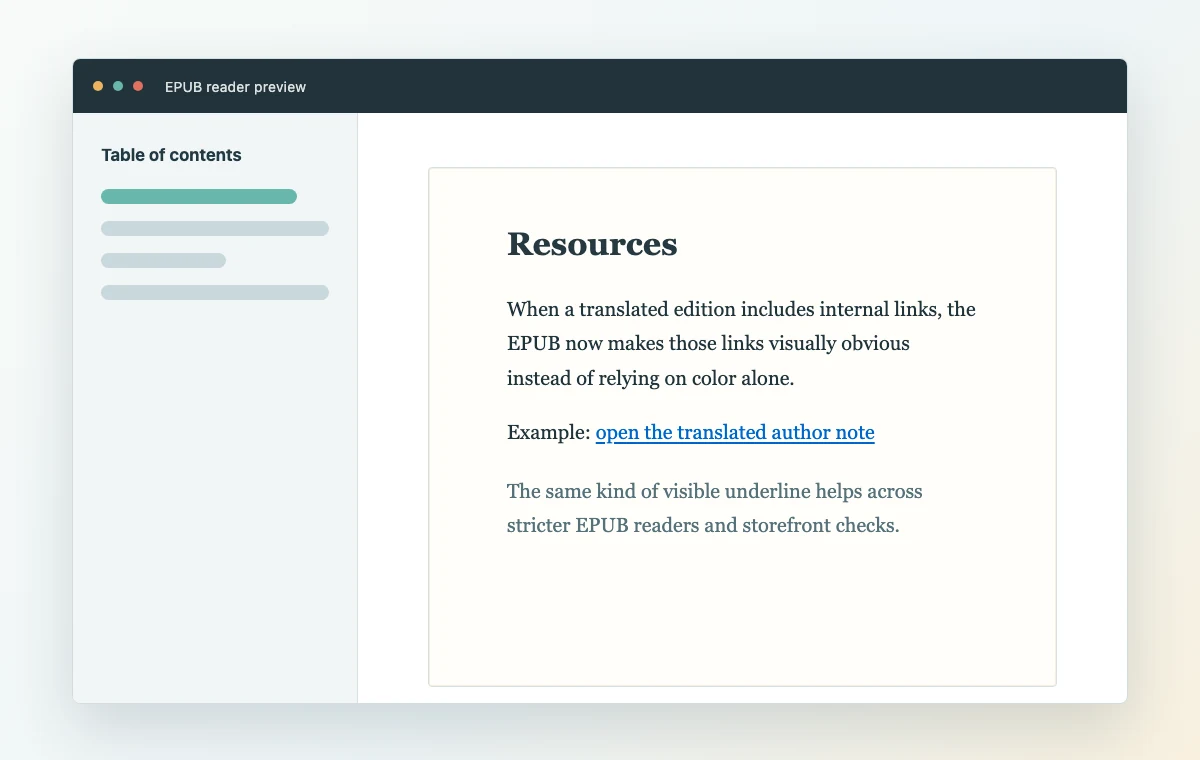
That is not about decoration. It is about reducing the chance that a file looks fine in one reader but becomes unclear, or fails a stricter check, somewhere else.
Paperback wraps now handle KDP Groundwood
The paperback wrap generator now includes Amazon KDP's Groundwood paper option.
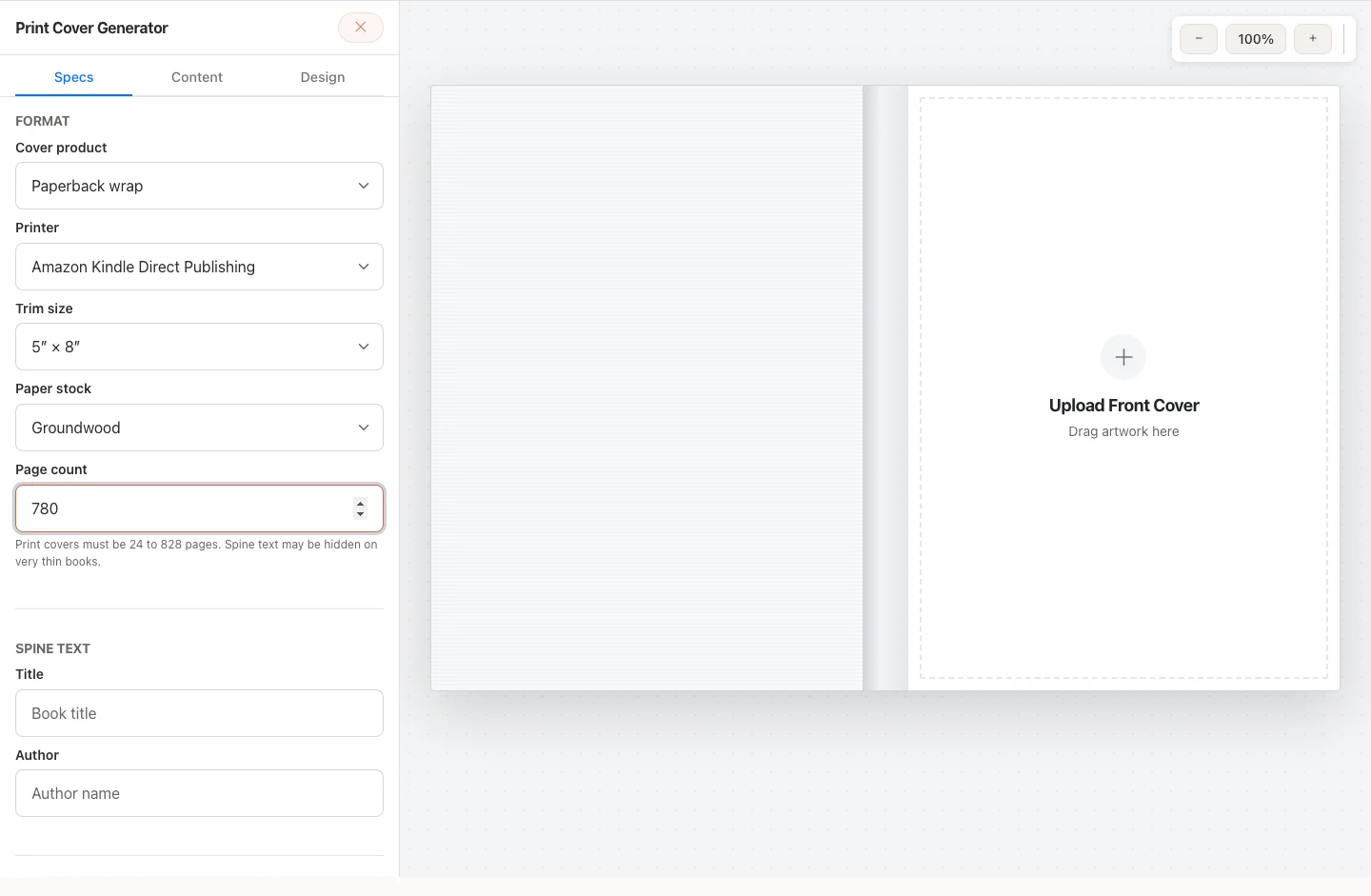
That sounds like a tiny dropdown change, but print cover setup is physical. Spine width depends on paper stock, page count, and trim size. If the paper setting is wrong, the wrap can drift even when the artwork looks fine on screen.
Bookshift now accounts for the Groundwood spine size and page-count limits, so authors preparing KDP paperbacks with Groundwood do not have to approximate with another paper type.
Cover and translation flows are harder to misunderstand
There has also been a lot of cleanup around the places where authors can accidentally choose the wrong path.
Cover translation is one of those places. Sometimes a translated cover is included with the book translation. Sometimes an author is creating a separate paid cover job. Sometimes they are uploading a replacement. Those are different actions, and the page should not make anyone guess which one spends credits.
Bookshift now uses clearer free-vs-paid labels around cover actions and does more to block duplicate paid cover orders when an included translated cover is already waiting, being created, matching a series style, or completed. Instead of letting a duplicate job go through, Bookshift points the author back to the included-cover option and explains what to use next.
The translation submit page also got clearer feedback when something is missing before a job can start.
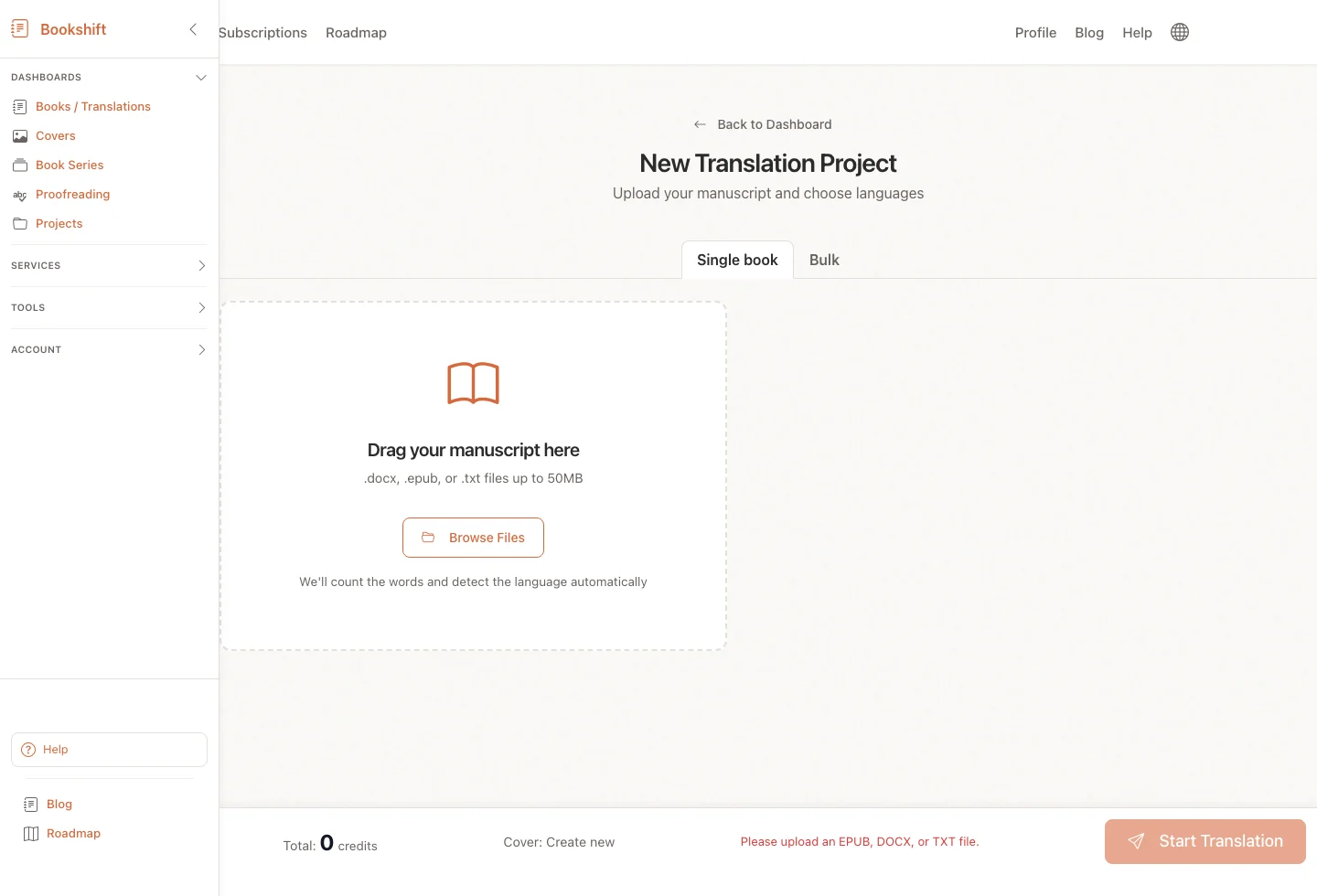
That is not exciting in a screenshot, but it matters in real use. If a file is still being read, a language is missing, or something else needs attention, the page now has a clearer place to say what is wrong.
Generated covers also got a practical polish pass. Bookshift now nudges new covers toward more readable, commercially usable lighting, especially for darker genres where the title and author name still need to survive as a small retailer thumbnail. A dark cover will automatically receive a brighter version as well, which becomes the default. The original darker version is preserved and can be downloaded from your cover page.
Added languages and title suggestions should hold together better
Another area that needed improvement was follow-through when authors build a translated catalog gradually.
If you finish a translation job and later add another target language, Bookshift now does more to treat that new language as its own finished job. That means the completion email can be sent again when the new language finishes, instead of being blocked just because the original job already had a completion email.
That matters when a book starts with German, then adds French, Spanish, Italian, or another language later.
Bookshift also tightened up how translated title and subtitle suggestions are saved when more languages are added to an existing job. When Bookshift suggests more than one title or subtitle option, those alternatives should still be available when you return to the book page later.
A translated title is not just a literal string. It is a market-facing choice, and it helps to keep the alternatives and recommended option visible while you review.
Translated pages, legal pages, and help material got cleaner
Some smaller updates were about trust and clarity rather than new features.
Translated product pages and book-page messages got cleaner in a few places, with fewer English leftovers where the page is already meant to speak the author's language. The signup page now references the Terms of Service and Data Processing Agreement together, and Bookshift has a dedicated Data Processing Agreement page at /legal/dpa.
The help material also kept improving, including broader getting-started guidance for authors who want the map before they upload a book.
Better support for Tolino
Tolino has some of the strictest requirements among the retailers and distributors our authors use, and those stricter requirements have often caused problems. Bookshift has improved its covers, EPUBs, and DOCX files to meet Tolino's requirements more reliably.
A quick audiobook note
Audiobook development has also been moving forward, but I do not want to make it the main headline yet.
The current status is that audiobooks are nearly ready for beta testing. The recent work has focused on choosing who speaks each line more carefully in dual-narrator and full-cast scripts, especially in first-person narration, POV-heavy scenes, and books where a line is ambiguous.
In plain English: the system should be less eager to "fix" who speaks a line unless the book gives it enough evidence. That matters for fiction, where a wrong voice can make a scene feel off immediately.
There is also preparation work around finding the cast and setting up voices, with the goal of making audiobook production feel guided without asking authors to solve every casting problem by hand before the draft is ready.
What this adds up to
The last few weeks have been about practical publishing readiness.
Bookshift is not just trying to produce translated text. It is trying to help authors get from manuscript to publishable edition: translation, EPUB, DOCX, cover, print wrap, title choices, completion emails, and review-ready files.
That means some of the best updates are intentionally quiet. They are the ones that keep a scene divider from breaking, stop a duplicate cover charge, make a heading easier to read, or make sure the next language in a series gets its own proper handoff.
That is the direction I want Bookshift to keep moving: less like a translation box, more like a practical publishing workflow for authors and small publishers building real international catalogs.